Conflict Minerals
A case study in regulation that doesn't work
Section 1502 of the Dodd-Frank Act requires publicly traded companies to investigate and disclose whether their products contain tin, tantalum, tungsten, or gold that originated in the Democratic Republic of the Congo or an adjoining country. The goal — cutting off mining revenue to armed groups — was humane. The mechanism — securities paperwork cascading down the industrial supply chain — was not up to the job. Fifteen years on, the evidence is in: enormous cost, a self-perpetuating compliance industry, and, by the government's own assessment, no improvement in peace or security on the ground. LIFT has been making this case since 2015.
What compliance actually looks like
Before a single supplier questionnaire is answered, a company must first navigate the SEC's own decision tree for whether and how the rule applies. This is that decision tree, from the SEC's compliance guidance:
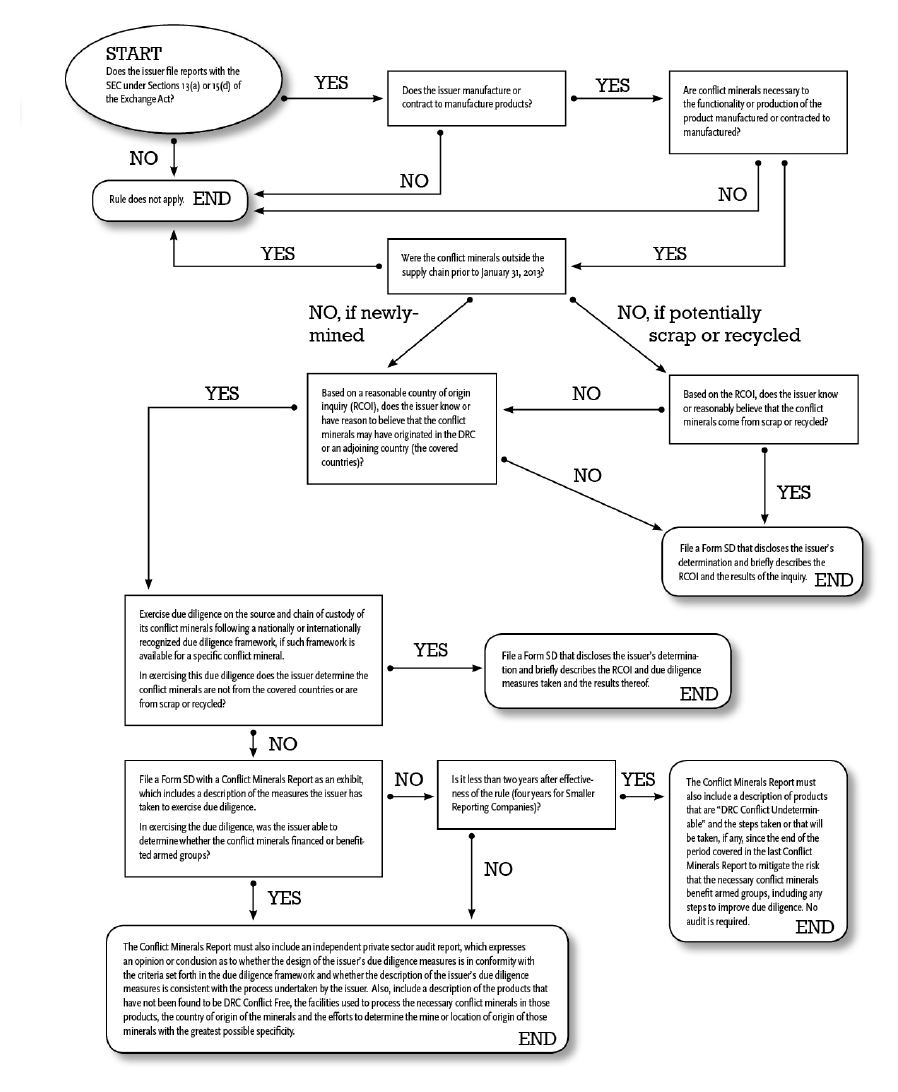
The SEC's own flowchart of the conflict minerals rule. Source: U.S. Securities and Exchange Commission.
Every "YES" branch leads deeper: a reasonable country of origin inquiry, due diligence against an international framework, a Conflict Minerals Report, in some cases an independent private-sector audit. Each step generates the supplier questionnaires that cascade down the supply chain — onto companies the rule never named.
Who actually does the work
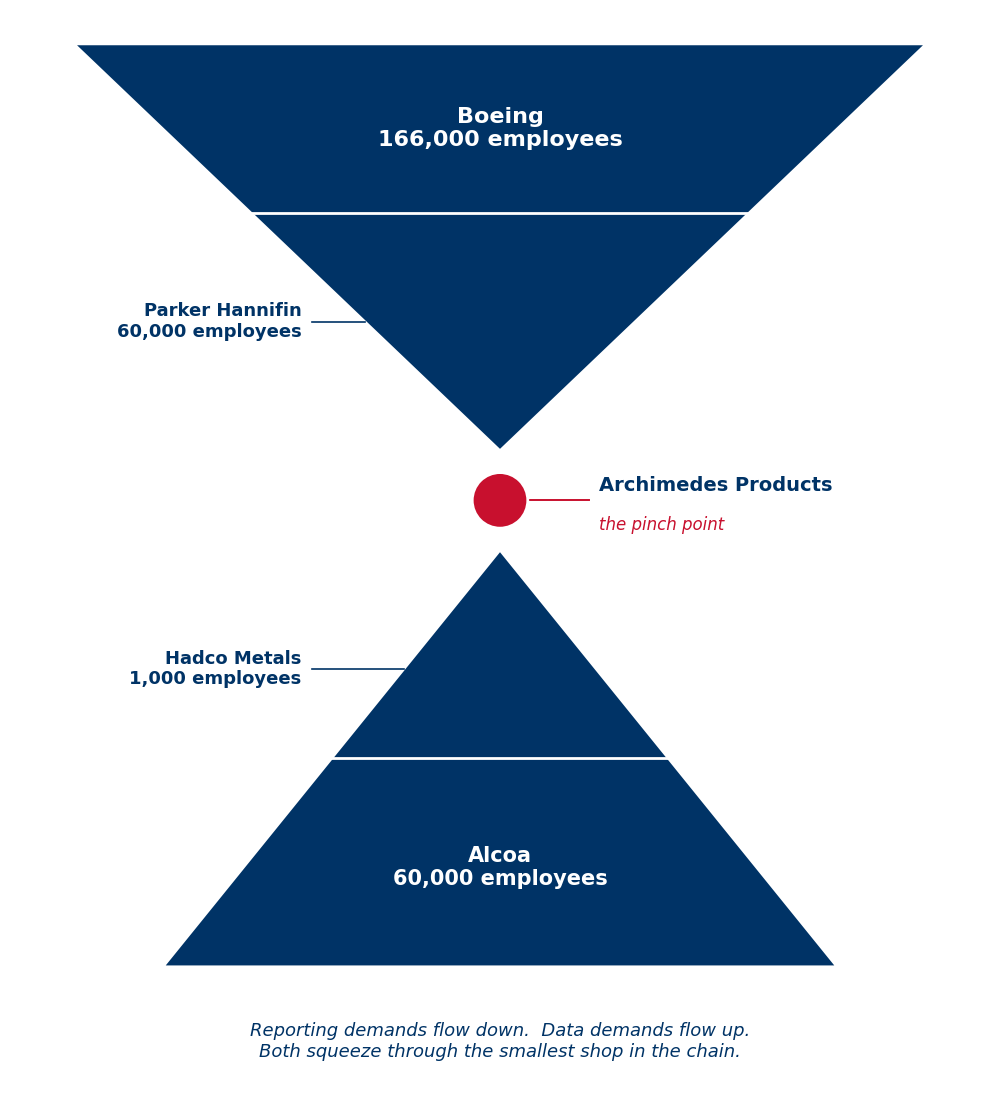
The defense supply chain, point to point. Archimedes Products is one of roughly 250 such companies on Long Island — put any of their names at the pinch point.
The reporting obligation belongs to the public company at the top. The work lands at the pinch point. A small machine shop answers a different conflict minerals questionnaire, in a different format, for every customer above it — uncompensated, and under the implicit threat of losing the work — while chasing certifications from its own suppliers, who often answer vaguely or not at all. And the certainty being demanded is structurally unavailable: by the time tin is in a solder joint or tantalum is in a capacitor, its origin has passed through traders, brokers, and smelters scattered across the globe — the part of the pyramid no one at the pinch point can see.
The arithmetic nobody did
The SEC estimated the rule would cost $3–4 billion in the first year and $207–609 million every year thereafter — and conceded it could not quantify any benefit. Roughly 6,000 public companies are covered; give each 20 suppliers and the reporting web spans well over 100,000 firms. In our 2015 brief to New York congressional offices we did the simple math: two compliance staff per public company and a third of a full-time employee per supplier works out to some 52,000 Americans working full-time on Congo paperwork. As we asked then: if the United States wanted to commit 52,000 people to central Africa's problems, would filing forms in filing cabinets be the way to deploy them?
The mini-industry the rule created
A regulation this convoluted does not just impose costs — it creates a market. Questionnaire software platforms, third-party audit firms, smelter certification programs, specialty consultants, law-firm compliance practices, annual conference circuits: an entire compliance industry now exists whose revenue is the rule itself. None of that spending adds a dollar of value to any product, and all of it constitutes a standing constituency for keeping the rule alive. When a regulation's most measurable output is the industry that services it, the regulation has failed a basic design test.
It didn't work — the government's own verdict
This is no longer a matter of opinion. In October 2024, after a decade of congressionally mandated annual reviews, the Government Accountability Office concluded that the SEC disclosure rule has not improved peace or security in the Democratic Republic of the Congo. Independent commentators reached the same verdict years earlier — Forbes called Section 1502 "the worst law of the year", observing that the paperwork costs alone exceed all annual U.S. aid to the DR Congo, and that such improvements as exist on the ground came from initiatives that predate the rule.
The minerals found a way around the paperwork
Worse than ineffective, the reporting regime is now being actively defeated. A 2025 UN Group of Experts report documented mineral smuggling at unprecedented levels: Rwanda's cassiterite exports jumped 58% in a single year — from 4,859 to 7,700 tonnes — precisely as armed groups expanded into the DRC's richest coltan-producing territory, an increase Rwanda's own mines cannot explain. Global Witness has traced smuggled Congolese coltan crossing into neighboring countries, acquiring clean paperwork, and entering the world's electronics supply chains as certified conflict-free material — much of it processed in jurisdictions beyond the reach of any meaningful audit. The minerals found cleansing paths through peers and adversaries alike. The forms get filed either way.
Where things stand today
The rule is still in force — Form SD filings were due June 1, 2026 — yet it has been half-abandoned since 2017, when the courts struck down its core labeling requirement on First Amendment grounds and the SEC stopped enforcing the full rule. Independent audits are effectively voluntary; most companies file complete reports anyway out of legal caution. So the paperwork machine runs at nearly full speed for a rule the government will not fully enforce and the GAO has judged a failure. And because Section 1502 is statute, not just an SEC regulation, only Congress can repeal it — which is why this argument belongs in congressional offices, where LIFT first took it in 2015.
What would actually work
The instruments that moved conditions in the region in 2025 were not disclosure forms. They were targeted U.S. sanctions on entities financing the conflict and State Department-brokered diplomacy between the DRC and Rwanda. That is the pattern to follow. LIFT advocates repealing Section 1502 and redirecting equivalent resources to the institutions built for this job: Department of State diplomacy, sanctions, and development programs; Department of War supply-chain security programs that secure critical minerals directly; and Customs enforcement at the border — as our 2015 brief put it, if we don't want conflict minerals, embargo them. Direct action by the agencies whose mission this is, instead of paperwork by 52,000 people who can't see past the next tier of their supply chain.
We've been saying this since 2015
LIFT presented this argument to two New York congressional offices in 2015 — nine years before the GAO reached the same conclusion. The original brief, lightly edited for typography, is available here:
Sources: GAO-25-107018 (2024) · SEC conflict minerals compliance guide · Forbes (2017) · UN Group of Experts reporting (2025) · Global Witness coltan investigation